From Reactive to Predictive: How AI Is Redefining the Future of Customer Experience
Modern CX leaders are using Axion to modernize service operations, reduce costs, and deliver smarter, anticipatory support - with real-world examples of teams analyzing cases in near real time, uncovering churn drivers, and preventing costly product defects

Axion
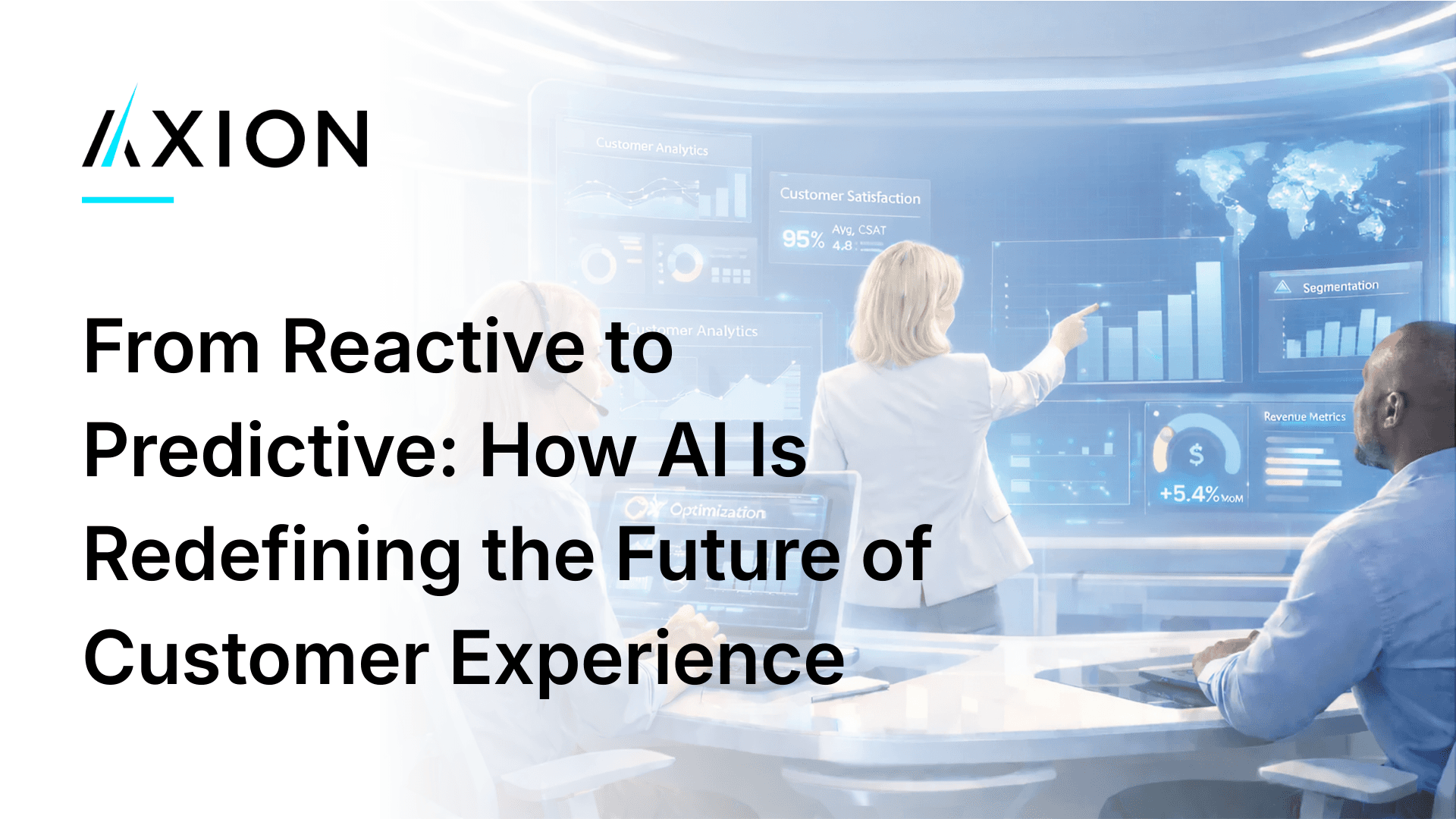
Customer experience (CX) leaders today face an impossible challenge: managing thousands of daily customer interactions while trying to extract actionable insights that will help them prevent future issues. Every call, chat, and email contains valuable information about customer satisfaction and product performance, yet most teams remain overwhelmed by volume and underpowered by intelligence. Traditional methods leave CX organizations drowning in data but starving for clarity; they manage by reacting to problems rather than anticipating them.
Customer feedback is available via massive amounts of unstructured information across multiple channels, and hidden within that noise are the early signals of what customers love - and what might soon go wrong. The ability to capture and act on those signals makes the difference between reactive service and proactive leadership. By converting unstructured conversations into predictive insights, CX leaders can shift from firefighting to foresight - building operations that not only resolve issues faster but also prevent them entirely.
Based on extensive customer conversations and real-world implementations, we share here how heads of customer experience and call center operations are leveraging Axion to modernize their service organizations, reduce costs, and deliver smarter, more anticipatory support.
The Modern CX Dilemma: Too Much Data, Hidden Insights
Ask any head of customer experience what keeps them up at night, and you’ll likely hear a version of the same problem: “We have all the data, but it isn’t telling us what to do next.”
One CX director described it succinctly: “We’ve closed over 40,000 cases since launching a new system. That’s good information, but without intelligence we’re just closing tickets. AI helped us identify trends by the hour instead of waiting for quarterly reports.”
This paradox of having more data than insight has defined the last decade of CX operations. The new frontier is actionable intelligence: the ability to detect emerging issues in real-time, uncover root causes across channels, and convert conversations into decisions.
Empowering Agents with the Right Data At The Right Time
The best CX transformations start not with technology itself, but with how it empowers people. Consider a global manufacturer whose service agents once juggled Salesforce, SAP, manuals, and two to three screens just to resolve a single issue. Every extra click cost time, focus, and accuracy.
Those agents now receive the right information at the precise moment they need it - whether it’s identifying the correct spare part or identifying an unnoticed link between different issues. The result is reduced handle time, less friction, and better job satisfaction. As the operations manager put it, “We stopped making our agents hunt for data and started letting data find them.”
From Problem Solving to Problem Prevention
CX leaders are also realizing that the most powerful customer insights often emerge from patterns hidden across thousands of micro-interactions. While important, traditional benchmarks such as handle times, response rates, and satisfaction scores, only capture a small part of this story; they fail to “connect the dots” that can reveal hidden insights and enable targeted root-cause analysis.
For instance, a leading consumer goods company used Axion to analyze real-time call transcripts and detect early spikes in product complaints. Within hours, their quality team identified a manufacturing defect before it spread further. Instead of damage control, they launched proactive communication with customers and resolved the issue before it escalated. What could have been a costly recall turned into a demonstration of responsiveness and reliability.
Another example of transformation is enabled by “connecting the dots” that reveal hidden insights. In this scenario, the product company had no clear picture of why it was that they were losing customers. They tracked churn but not causation. After implementing Axion’s human-in-the-loop AI platform, they could finally link attrition to specific service bottlenecks and calculate their true financial impact. With that clarity, they redesigned retention programs to target high-value customers before they disengaged.
The ability to detect, analyze, and action hidden patterns defines the next generation of CX strategy, providing CX leaders with the intelligence to proactively take action.
Customer Experience Is a Leading Indicator for Product Design
Perhaps the most significant transformation lies in perception: CX teams are no longer seen as back-office cost centers but as strategic intelligence hubs that inform product design, marketing strategy, and corporate reputation.
There is real value in this shift, but it requires empowering CX teams to move away from manual, time-intensive analysis, to focus instead on higher-order thinking engagement with other teams. Using Axion, organizations report cutting response times from over 24 hours to under two. Agent performance improves through unified interfaces and automatic sentiment analysis, replacing manual call scoring. Quality auditing becomes continuous.
When customer feedback becomes a predictive asset, the CX function evolves from reactive support to proactive growth, aligning insight with business outcomes. “We used to guess what success would look like at launch. Now, we use data to confirm it before we ship.”
A Practical Roadmap for CX Transformation
For CX leaders ready to embrace AI-powered customer intelligence, a phased approach ensures sustainable success:
Phase 1 – Real-Time Issue Detection: Capture and surface emerging problems as they arise.
Phase 2 – Cross-Channel Analysis: Connect every customer interaction into a unified view.
Phase 3 – Predictive Insights: Leverage historical data to prevent recurring issues.
Phase 4 – Integrated Workflows: Embed insights directly into agent tools and systems.
The most successful CX organizations are those that can turn customer conversations into competitive intelligence. As one customer insights leader put it: "We can then use all these data points, these datasets, find a way to make connections or predictive modeling... that will help us gain confidence pre-launching that what we know has set up this thing to be as successful as we want it to be."
Ready to transform your customer experience operations? Learn how Axion can help your team turn customer conversations into competitive advantages - schedule a demo of our platform with your own data.
Share