Beyond the Ticket: Bridging the "Intelligence Gap" Between Engineering and Service
AI-powered intelligence closes the gap between engineering and service by connecting product insights and powering automated workflows that update knowledge, trigger proactive outreach, and enable precise field interventions.

Axion
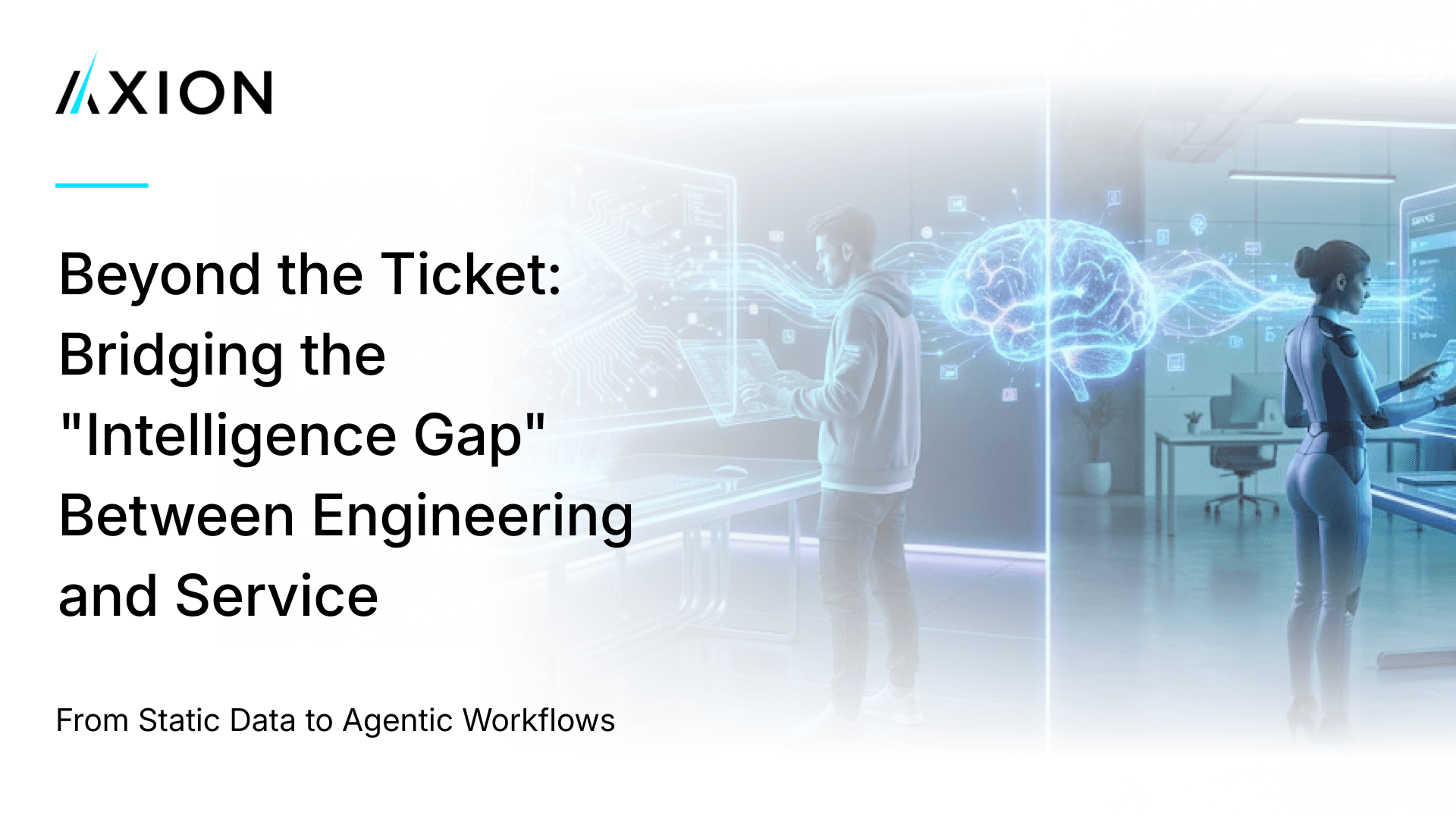
The "System of Engagement" Trap
In the modern enterprise, organizations have perfected the art of recording the "who" and "when" of customer issues. Your CRM knows exactly who called, when they called. This is the strength of a System of Engagement.
But there is a critical piece of the puzzle often missing from the service agent’s screen: the "Why." Why did the product fail? Is this a one-off anomaly, or the start of a massive supplier defect? Has engineering already fixed it?
Usually, the answers to these questions are trapped in a silo, buried in unstructured data, engineering logs, or lab reports. By the time this "Product Intelligence" makes its way to the "System of Engagement," weeks have passed. Returns have been processed, warranty costs have spiked, and customer trust has eroded.
At Axion, we believe the next frontier of Customer Experience (CX) isn't just about better scripts or faster routing. It is about bridging the gap between the Intelligence Layer (Axion) and the Engagement Layer (Salesforce).
The Vision: From Static Data to Agentic Workflows
The conventional approach to integration is simple "data visibility," showing a dashboard of quality metrics inside a CRM. We are aiming for something far more powerful:
Agentic Workflows: By combining Axion’s ability to detect root causes with Salesforce’s Agentforce, we can move from merely displaying problems to automatically resolving them.
Here is what that looks like in practice.
1. The "Self-Healing" Knowledge Base
The Status Quo:
Engineering identifies a firmware bug and releases a fix. It takes weeks for that information to trickle down to the Service capabilities team, get written into a bulletin, and finally reach the call center agents. In the meantime, call center agents are troubleshooting a problem that has already been solved.
The Connected Vision:
Detection: Axion detects a spike in specific error logs and correlates it with a recent firmware update, connecting the dots between the emerging trend and the engineering fix.
Intervention: An automated workflow pushes this insight directly into Salesforce, drafting a new Knowledge Base artifact for service teams.
Result:
The next time an agent opens a similar case, time to closure is accelerated; the solution is already there, provided by an automated ‘self-healing’ database that corrects and improves upon itself automatically.
2. The Proactive "Unboxing" Intervention
The Status Quo:
A customer unboxes a new product and can’t find a specific part. Frustrated, they post a negative review or return the item. You only find out when the RMA (Return Merchandise Authorization) hits the system.
The Connected Vision:
Ingestion: A customer scans a QR code to upload an unboxing video or warranty registration.
Analysis: Axion analyzes the video data and detects a "missing part" complaint or user confusion.
Intervention: Instead of waiting for a support ticket, a Salesforce Agent (powered by Agentforce) recognizes the specific issue context from Axion. It automatically triggers an outreach: "We noticed you might be missing Part X. We’ve already shipped a replacement to you."
Result:
A potential detractor becomes a promoter before they even pick up the phone.
3. Precision Field Actions
The Status Quo:
You suspect a defect in a specific batch of products. To be safe, you email everyone or issue a broad recall, causing unnecessary panic and cost.
The Connected Vision:
Segmentation: Axion identifies the specific risk cluster - perhaps limited to a single supplier batch or date range.
Intervention: This intelligence feeds directly into Salesforce Field Service. Work orders are automatically generated only for the affected units, and technicians are deployed with the exact repair instructions derived from Axion’s root cause analysis.
Result:
A potentially costly recall can be turned into precision intervention before it starts to affect customer experience, downtime or safety.
Why This Matters for the C-Suite
This integration isn't just an IT project; it is a fundamental shift in how your organization handles risk and reputation.
When you embed the Intelligence Layer (Axion) directly into the Engagement Layer (Salesforce), you effectively give every service agent the collective knowledge of your engineering department. You stop treating service and quality as separate departments and start treating them as a unified loop.
You don’t need to wait for a full system overhaul to start closing the gap. Here are three things you can do today:
Audit Your "Intelligence Latency": Measure the time it takes for a known engineering fix to become a usable script for your call center agents. If it’s more than 24 hours, then you have an opportunity to accelerate.
Map the Unstructured Journey: Look at where your "messy" data lives (returns notes, unboxing videos, technician comments). Ask how that data could trigger an automatic workflow in your CRM if it were made available in a more usable format.
Rethink the "Ticket": Stop viewing support tickets as administrative tasks. View them as data points that should automatically trigger upstream investigations in engineering.
Let’s Connect Your Worlds
The technology to connect your product intelligence with your customer engagement is already here. The only missing piece is the strategy to wire them together. If you are ready to explore how Axion’s intelligence layer can drive agentic workflows in your Salesforce environment, I’d love to walk you through some specific use cases we are developing, contact us.
Share