


Root Cause Analysis in Manufacturing: The Complete Guide
Root cause analysis in manufacturing is a structured method for finding the underlying reason a defect, failure or nonconformance happened, so the corrective action stops it from ...

What is quality intelligence? In manufacturing, quality intelligence is the practice of connecting quality data from every stage of a product's life so quality teams can spot product issues early and trace each one to a root cause. That data includes but is not limited to plant NCRs and SPC charts, warranty claims, service records, supplier notices, and field failure reports. You get one view of an issue in place of five partial ones. That means fewer escapes reaching customers and a lower cost of poor quality.
Most organizations already collect the right data, but it sits in different systems, each with its own vocabulary:
A pattern that spans multiple teams often stays invisible until it shows up as a warranty spike or a field action, which is the most expensive point to find it. ASQ calls these losses the cost of poor quality: the costs tied to providing poor-quality products.
Search for "what is quality intelligence" and most answers come from software. The term means different things in different fields:
|
Field |
What quality intelligence means |
Typical inputs |
|
Software QA teams |
Judging release readiness and flagging release risk and delivery risk before code changes reach the release pipeline |
Requirements, acceptance criteria, test cases, pass rates, test coverage, flaky tests, CI/CD pipelines |
|
Contact centers |
Scoring customer conversations against quality standards |
Call recordings and agent interactions |
|
Manufacturing |
Detecting product issues early and tracing them to a root cause |
Plant NCRs and SPC data, warranty and service records, supplier and field data |
In software quality engineering, quality intelligence (QI) is a connected system spanning requirements, code, and production metrics, and much of that content is about transforming quality assurance with test automation and autonomous testing. Manufacturing quality intelligence keeps the core idea (join scattered quality signals, then act on the pattern) and applies it to physical products. The evidence is a torque reading, a returned part or a supplier lot number, and a missed signal can become a field failure or a regulatory report.
A quality management system (QMS) is where quality processes are documented and controlled, while quality intelligence reads across data sources to find and explain product issues.
The two work side by side. Your QMS holds controlled documents, NCR and CAPA workflows, and audit records. Quality intelligence brings a view across the QMS and the systems it does not cover, such as warranty, service and field data, so you know which issue matters most and why it is happening.
|
QMS |
Quality intelligence |
|
|
Main job |
Run and document quality processes |
Detect, investigate and explain product issues |
|
Data |
Records created inside the QMS |
QMS records plus plant, warranty, service, supplier and field data |
|
Output |
Controlled documents, workflow status, audit trail |
Emerging issues, linked evidence, likely root causes, recommended actions |
|
Typical users |
Quality management, document control, auditors |
Quality, reliability and field engineers and their leaders |
Regulated industries need both. For medical device makers, FDA's Quality Management System Regulation, in effect since February 2, 2026, incorporates ISO 13485 by reference. Quality intelligence helps a CAPA start from stronger evidence, and the QMS still documents and controls it.
Quality intelligence uses quality data from three stages of the product lifecycle, plus the supplier and customer data that touches each one. Common sources include but are not limited to:
|
Lifecycle stage |
Typical sources |
What it shows |
|
In-plant quality |
In-process inspection, statistical process control (SPC), end-of-line test, plant NCRs |
Whether the process is drifting before product ships |
|
Launch and warranty |
Out-of-box audits, warranty claims, dealer and service complaints |
How the system behaves in its first months with customers |
|
Field and failure analysis |
Field reliability, returns and teardown, FA reports, CAPA history |
Why parts fail and whether past fixes held |
One defect rarely looks the same twice. A slightly out-of-spec seal can appear as an SPC excursion at the plant, a "water all over the counter" complaint in customer experience data and a "gasket deformation" note in a teardown report. Quality intelligence helps by joining those records on the same component and failure mode, so defect patterns surface while they are small and before customer satisfaction suffers.
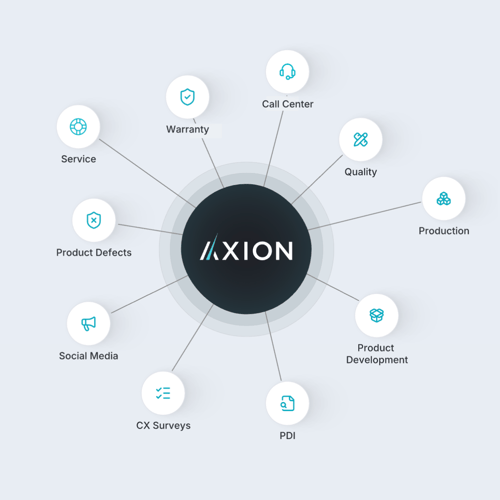
AI agents find quality issues earlier by reading every new record across your sources, grouping reports that describe the same problem in different words and flagging clusters that rise above their normal rate.
Take a hypothetical case. An aircraft fleet sees about one fuel tank issue a year. In one month, three appear at three airports:
No single team sees a trend. An agent that links all three to the same part number can find that the tanks came from one supplier batch made with the wrong material, and flag it before the next shipment.
This is automatic issue detection in practice: artificial intelligence and machine learning detect anomalies in production signals and field data, and an engineer confirms what they mean.
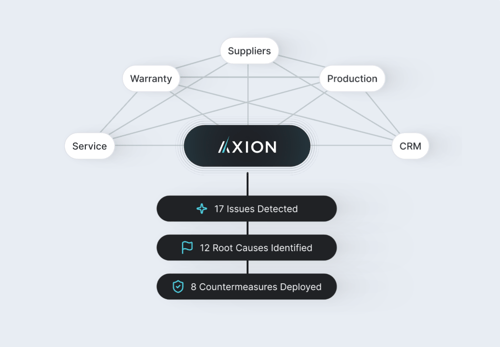
A general AI model is strong at language, but on its own it reads each dataset in isolation and forgets the last investigation when the session ends. AI built for manufacturing quality adds three things:
That is the difference between consumer-grade AI help and AI-powered quality intelligence built for manufacturers.
See which emerging issues AI agents find in your own quality data. Request a demo.
Implementing quality intelligence takes three steps:
Your existing tools (ERP, PLM, service system, QMS) stay in place, and quality intelligence software reads from them instead of becoming a separate system to feed by hand.
Teams that adopt quality intelligence well start small. Pick one product line or one costly known issue, and tie it to business goals, such as fewer days from first complaint to confirmed root cause. That gives your team a fair test of any quality intelligence platform: does it find what you already know, and does it find something you did not?
The taxonomy step matters most. It encodes how your business works (part relationships, failure modes, a business rule such as which plant builds which variant), and it is where your engineering teams' knowledge goes into the system.
Not sure which product line to start with? Talk to Axion about a first use case built on your own data. Contact Axion.
Every finding goes to an engineer for human review before anyone acts on it. People keep decision-making authority, which is what "human above the loop" means.
|
AI agents |
Engineers |
|
Surface the emerging issue |
Decide whether it is real and how urgent it is |
|
Assemble the linked evidence |
Check it against what they know about the product |
|
Draft the root cause |
Approve, reject or correct it |
|
Propose corrective actions |
Choose the action and own it |
Every review goes back into the system. When an engineer rejects a root cause, that correction updates the taxonomy, and each approved root cause becomes historical data for the next investigation. This feedback loop is how quality intelligence supports continuous improvement and surfaces new improvement opportunities, with human judgment on record for every decision. That audit trail matters in regulated industries.
An agent can populate an 8D report or a fishbone diagram from the linked evidence, using the template your team already works with, and the engineer edits and signs off. For the method behind those documents, see this guide to root cause analysis in manufacturing.
Quality teams at global manufacturers use Axion, a quality intelligence platform, to stay ahead of emerging issues and resolve the ones with the most business impact first. Axion connects to the data sources above and runs AI agents inside a harness built for manufacturing quality, and your engineers approve every finding before anyone acts on it.
Published Axion case studies show what quality teams have achieved:
If you are asking what quality intelligence is because a field issue took too long to explain, the clearest answer is to see it run on your own data.
Request a demo of Axion / Contact Axion
Root cause analysis in manufacturing is a structured method for finding the underlying reason a defect, failure or nonconformance happened, so the corrective action stops it from ...

Five whys root cause analysis in manufacturing asks why a problem happened, then asks why again of each answer, usually about five times, until the team reaches a process cause it ...

Fishbone diagram root cause analysis is a structured approach to finding why a manufacturing defect happens. You map the possible causes of the problem onto a cause-and-effect ...