Quality without Compromise: The Power of ‘AND’ with Axion AI
Breaking the Iron Triangle: How Schneider Electric Uses Connected Intelligence to Deliver Speed, Cost, and Quality All at Once

Axion

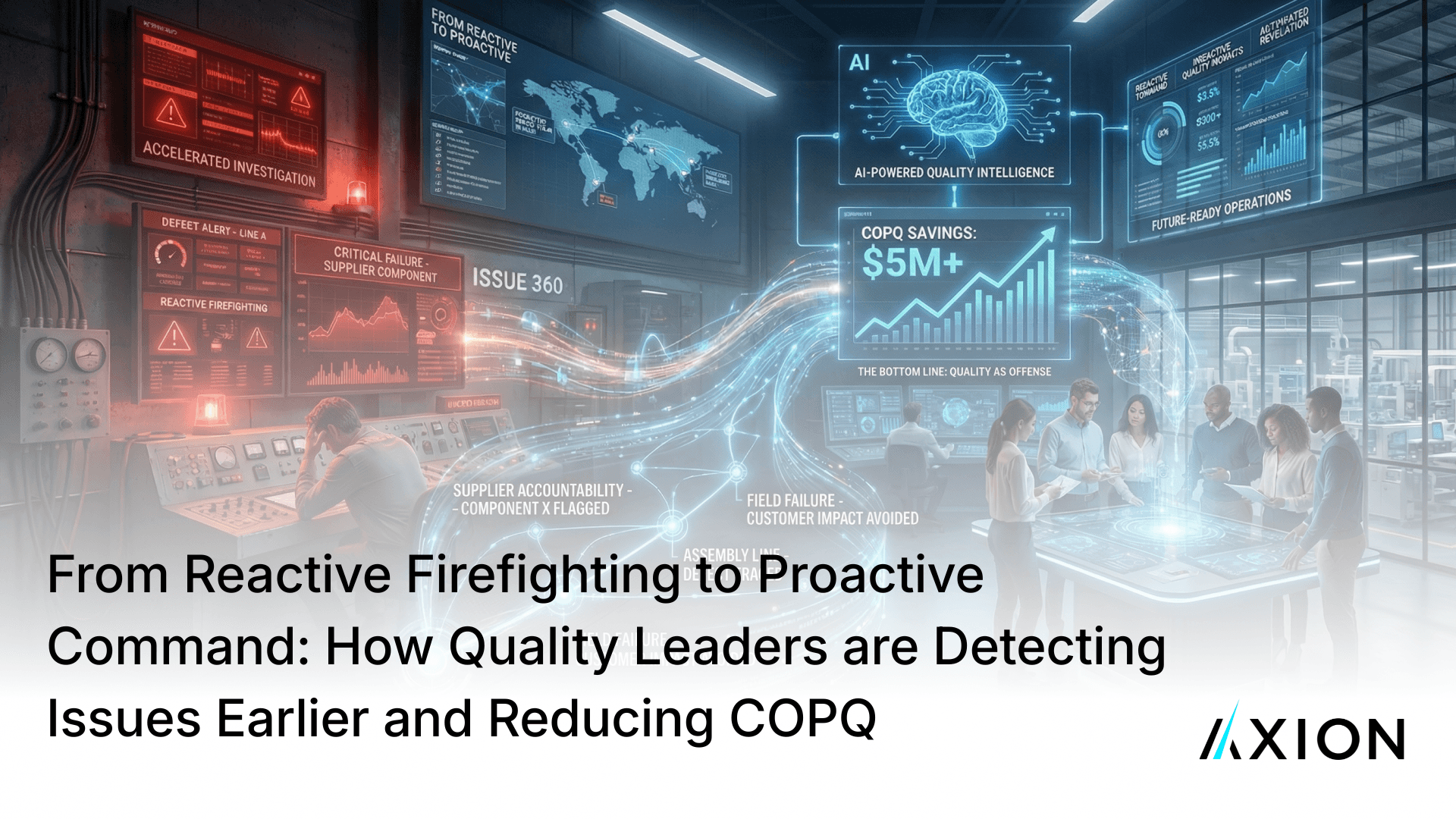
For decades, quality leaders have been handed the same impossible mandate: move faster, spend less, and never compromise on quality. The iron triangle, (good, fast, cheap - pick any two), was treated as a law of physics. Something to manage around, not solve.
"The old trade-off between speed and quality is dead. We use AI to deliver both, shifting from reactive firefighting to predictive leadership.” - Dr. James Ezhaya
Schneider Electric is pushing the boundaries of this previously immutable guideline and proving that with Axion AI, quality leaders no longer need to settle for a compromise.
At Axion's most recent webinar, we sat down with Dr. James Ezhaya, SVP Industrialization & Supply Chain, at Schneider Electric, to explore what it looks like to operate at the frontier of AI-driven quality leadership. Schneider Electric operates across hundreds of plants in dozens of countries, with products in life safety applications where failure is not an abstraction. Dr. Ezhaya discussed the shift from reactive firefighting to connected, predictive intelligence, which he called the ‘Power of AND’.
The Signal Problem Quality Leaders Have Been Living With
Critical data is often siloed across disparate platforms: field service records in one, IoT telematics and fault codes in another, and customer feedback or engineering logs in a third. Most quality leaders have experienced this systemic fragmentation firsthand.
While individual teams work diligently within their respective systems, the lack of a unified intelligence layer means signals remain disconnected. Consequently, by the time a critical pattern finally becomes visible, the issue has already surfaced across multiple departments because no one was able to connect the dots in real-time.
The consequence of fragmented signals extends beyond slow detection; it creates compounding costs as issues escalate before they are identified. This fragmentation forces quality teams to be reactive, meaning they spend their energy fighting fires that could have been contained weeks earlier. The challenge today is not a lack of data, as quality leaders have access to more information than ever before. Rather, it’s a connected intelligence problem that requires a unified layer to turn those signals into actionable insights.
Creating a Cohesive View
One of the most instructive examples Dr. Ezhaya shared was a recurring nuisance rather than a catastrophic recall. Scheider Electric’s team, working with Axion AI, noticed a slight uptick in unstructured field signals indicating minor difficulties during product installation. Because these were not safety failures, they remained low-severity signals that rarely trigger formal investigations.
Simultaneously, disparate systems logged minor logistics flags from distribution centers and small process adjustments during final testing. While none of these signals crossed a traditional threshold independently, Axion connected these different systems to reveal a cohesive story. The intelligence layer identified that specific packaging and transport stressors were creating alignment issues visible only during installation. By unifying these data points, the team successfully adjusted the packaging design and installation guidance, permanently fixing the issue.
"A problem can show up in three different places before anyone realizes it's actually the same problem. Individually, those signals look small. Together, they are the early warning system of a systemic issue." - Dr. James Ezhaya
The Zombie Problem: Why Closed Issues Come Back
One of the most overlooked failure modes in quality is not a new problem, but rather an old one that remains fundamentally unresolved. Dr. Ezhaya characterizes these as 'zombie problems', instances where a team identifies an issue, executes the problem solving process, and closes the corrective action, only for the signal to disappear temporarily. Six months later, a variation of the issue inevitably resurfaces, and the team fails to recognize it because they believed the problem was resolved.
This recurrence is structural, driven by the fact that manual verification loops are too labor-intensive to maintain once a project enters the control phase. As teams pivot to new SKU launches and supplier lots rotate, the conditions that allowed the original issue to emerge quietly return. AI transforms this dynamic by deploying persistent agents that continuously verify past corrective actions across every plant, supplier lot, and customer segment. The strategic question shifts from whether a fix was implemented to whether that fix is currently holding across the entire system, representing a fundamentally different and more proactive operating posture.
Starting Is Simpler Than You Think
Dr. Ezhaya's advice is direct: begin with a specific, high-stakes problem rather than waiting for a broad platform or a total enterprise transformation. Quality leaders often hesitate due to concerns about readiness, citing unclean data, disconnected systems, or an incomplete AI strategy. By focusing on a known customer issue that is already incurring costs and generating signals within your ecosystem, you can connect the relevant data to see exactly what the system can learn. This targeted approach allows quality leaders to prove the value of the intelligence layer immediately, turning existing pain points into the first milestones of a predictive strategy.
“In manufacturing, we often get stuck in 'pilot purgatory.' With Axion, we moved from an initial pilot to board-level insights in hours, not years.” - Dr. James Ezhaya
Quality leaders who have seen the most traction with Axion are the ones who started narrow and moved fast, generating visible ROI from the first use case, building momentum within their teams, and expanding from there. Not waiting for a perfect AI strategy. Starting with a real problem and letting the results make the case.
At Axion, our mission is to help the world's leading enterprises solve their customers' product issues at the speed of AI. That work starts with one signal, one data set, one decision made earlier than it would have been before.
To learn more about how quality leaders are leveraging AI to detect and resolve product issues faster, reach out to the Axion team at or watch the full webinar on demand.
Share